

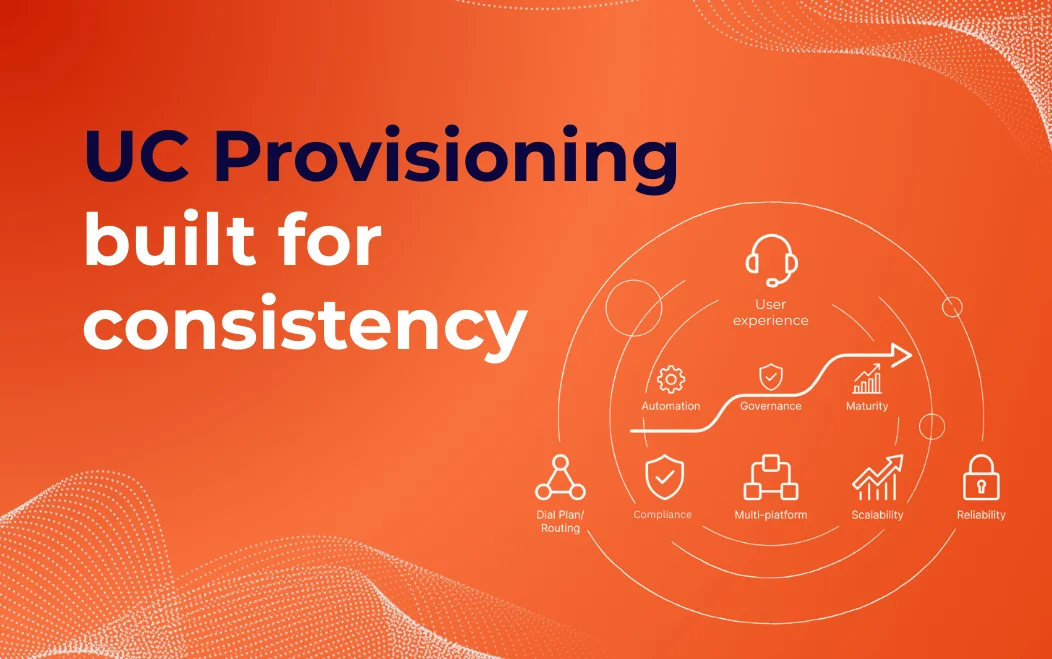
Automation solves the workload, but not the strategy
MACD automation removes manual work, but it doesn’t automatically resolve the structural inconsistencies that accumulate across UC environments. Routing rules differ, exceptions stack up, and legacy patterns persist.
Faster execution alone won’t fix that. What organizations truly need is predictable, governed provisioning that behaves the same way across every UC platform and customer. This is the difference between automating tasks and achieving provisioning maturity.
And the pressure is rising: industry research shows hybrid and multi-vendor UC environments are now the norm for more than half of large organizations, while centralized governance remains the exception.
In parallel, multi-vendor UC management is expanding at more than double the pace of single-vendor deployments, increasing the dependency on reliable provisioning processes.
Governance is no longer optional; it’s the foundation of scalable UC operations.
MACDs affect far more than provisioning speed
Once MACDs are automated, organizations start noticing impacts in areas that previously felt unrelated:
- Dial plan reliability improves. Fewer routing errors, escalations and surprises.
- Customer onboarding accelerates. Not because tasks are faster, but because dial plan management becomes predictable.
- Tenant growth becomes scalable. New customers no longer require weeks of pre-validation.
- Legacy PBX migrations gain structure. Automation removes the “manual interpretation” that often slows transitions.
- Compliance becomes auditable. Every change has a traceable, reviewable origin.
Where organizations get stuck between “manual” and “mature”
This is why automation alone doesn’t guarantee quality. Maturity requires structure.
- Number logic accumulated over 10+ years. Patterns, exceptions, and “temporary” rules become permanent liabilities.
- MACDs executed differently by each admin. Even with automation, inconsistent interpretation creates drift.
- Multi-platform complexity. Teams, CUCM, Webex, hosted PBXs: each uses different logic and syntax.
- Lack of a governance framework. Automation without standards ends up producing inconsistent results.
The Agile Provisioning Maturity Curve
Flexcom helps organizations progress through three stages that reflect increasing provisioning maturity and operational stability:
1. Task Automation
The foundation: eliminate repetitive work.
- Faster MACDs
- Fewer manual steps
- Up to 95% reduction in provisioning time
- Up to 95% reduction in daily admin effort
Automation removes friction — but governance defines outcomes.
2. Governance Consolidation
The system begins to “protect itself” from errors.
- Standardized prefixes
- Unified routing policies
- Automated number validation
- Automated conflict prevention
- Consistent logic across all UC platforms
This stage delivers the most visible improvements in stability.
3. Strategic Provisioning
Provisioning becomes predictable, scalable, and auditable.
- Predictable migrations across sites and platforms
- Stable tenant expansion without pre-validation overload
- Up to 80% reduction in operational cost tied to MACDs
- 3× productivity increase across UC admins and support teams
- Full auditability and governance at scale
This is the maturity level MSPs need to support complex hybrid UC environments sustainably.
Faster MACDs are good. Consistent MACDs are transformative.
By reducing workload through automation and reducing risk through governance, organizations build a UC ecosystem that is scalable, predictable, and resilient.
Flexcom Agile Provisioning supports this full maturity journey by combining faster execution with structured, governed, and auditable provisioning at scale.
If you’d like to explore how organizations advance from automation to governance, reach out at insights@flexcom.io